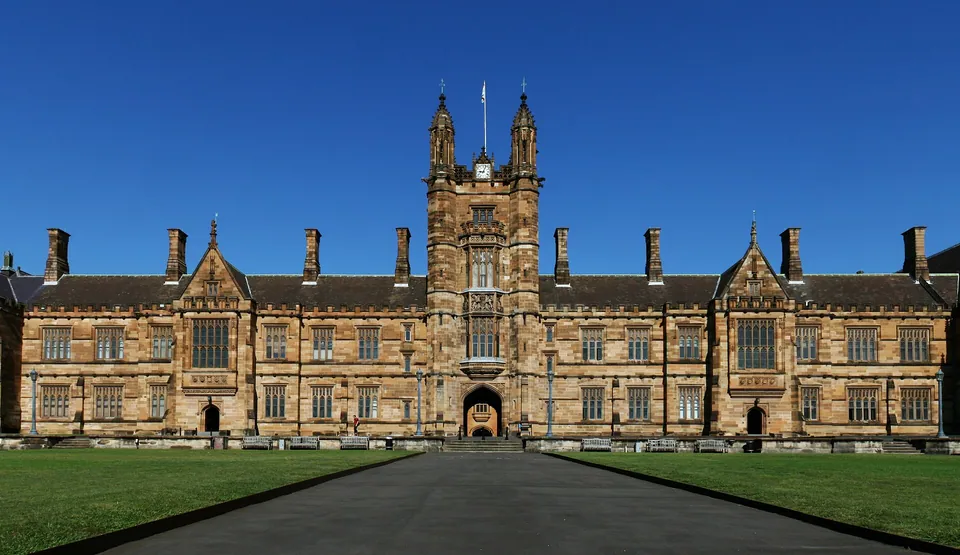
University of Sydney Quadrangle
Main Quadrangle, Camperdown
Edmund Blacket. From 1854, finished only in the 1960s. Sandstone.
- Size
- Great Tower about 27 m (secondary sources)
- Material
- Sydney sandstone, widely reported as Pyrmont yellowblock; slate roofs
- Status
- Local heritage item, within a campus on the State Register since 2018
Edmund Blacket resigned as Colonial Architect in the mid 1850s to design a university on the Oxford and Cambridge model, for a colony not yet 70 years old. The style was already out of date when it was built. It was also described as the largest public building in the colony. The first degrees were conferred in the Great Hall in July 1859.
Anthony Trollope, visiting in the early 1870s, wrote in his book Australia and New Zealand that the hall “is the finest chamber in the colonies”. He then hedged: if he said no Oxford or Cambridge college had so fine a one, “I might probably be contradicted”. Its hammerbeam roof recalls Westminster Hall, and twelve carved wooden angels among the beams hold emblems of the arts and sciences, including a harp for Poetry and an air pump for Physics.
The Quadrangle took more than a century to finish, and bequests paid for much of it. Thomas Fisher, a bootmaker and property investor, left £30,000 in 1885 to start a library, which joined the Quadrangle in 1909. It closed its four sides in 1926, and the last stones of the west tower were laid in 1966. The masons kept the grotesques of an English college and added local wildlife: a kangaroo looks out from the clock tower, with a crocodile on the inside and kookaburras over a northern door. A jacaranda planted in 1928 became the sign of exam season until it died in 2016.
The stone
The walls are Sydney sandstone, widely reported as Pyrmont yellowblock. A 2026 University article says Blacket drew it from the Pyrmont quarries known as Paradise, Purgatory and Hellhole. The oriel window and the arms of the Great Hall are carved in Caen stone imported from France. Joseph Popplewell, Edwin Colley and a mason named Barnet carved the gargoyles. The hall’s exterior stone was restored in 1987.
Sources
- University of Sydney Quadrangle, Wikipedia
- Great Hall of the University of Sydney, Wikipedia
- Celebrating 60 years of the Quadrangle, University of Sydney
- University of Sydney, Dictionary of Sydney
- University of Sydney receives state heritage listing, ArchitectureAU