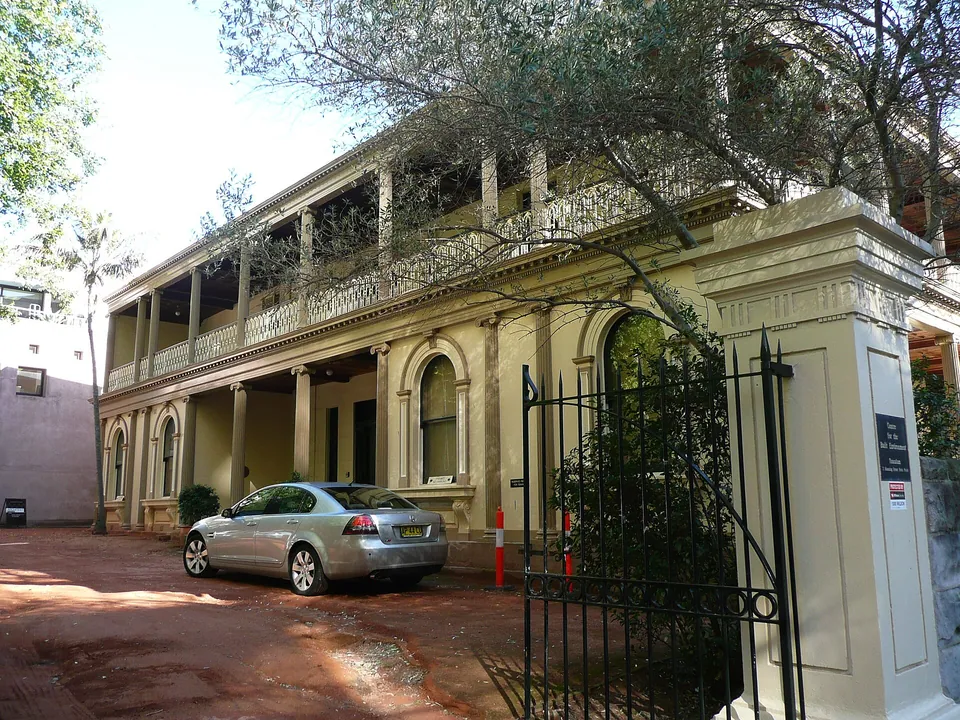
Tusculum
1-3 Manning Street, Potts Point
John Verge. 1831 to 1837; other accounts end in 1835 or 1836. Brick.
- Size
- Two storeys over a basement. About 18 m by 13 m on OpenStreetMap. Heights estimated from photographs
- Material
- Stuccoed brick, with a two-storey verandah of the Ionic order and cast iron balustrades. The low slate roof is now tiled
- Status
- State Heritage Register, 1999. Now offices
From 1828 Governor Darling granted land on Woolloomooloo Hill on what were called villa conditions: one house to a grant, to an approved design, set in its own grounds and usually facing the town. By the mid-1830s the “white” villas along the ridge could be seen from the harbour. Alexander Brodie Spark, a merchant who had arrived as a free settler in 1823, received more than nine acres and named his house after the Alban Hills town where Cicero had a villa. John Verge’s ledger runs from plans in 1831 to details for the front door pilasters in 1836.
Spark’s fortunes fell with the Bank of Australia and the depression of the 1840s, and he did not settle here. The first occupant was Bishop William Broughton, from 1836 to 1851, and the heritage listing ranks the house in his time second among the colony’s houses after Government House. Broughton called it “a sad, imperfect place and anything but episcopal in pretensions”. Bishops from across the region stayed for their conference in 1850.
William Long, an emancipist merchant, bought it in 1851, and his son made large alterations in the 1860s. The two-storey Ionic verandah probably dates from the 1870s, which turned a Regency villa into something closer to a Victorian Italianate mansion. John Burcham Clamp altered the stair for a later owner after an auction in 1904. Of the original 17 villas on the hill, five still stand. Its neighbour Rockwall, also by Verge, is of sandstone blocks.
It was a servicemen’s club during the Second World War and then a private nursing home, and it fell into disrepair. In 1983 it was compulsorily acquired, the first use of those powers under the NSW Heritage Act of 1977. The Royal Australian Institute of Architects then took a 99-year lease on the condition that it restore the house. Clive Lucas directed the conservation, Levine & Durbach won a competition for a new building behind, and both opened in March 1988.
Sources
- Tusculum, Potts Point, Wikipedia
- Rockwall, Potts Point, Wikipedia