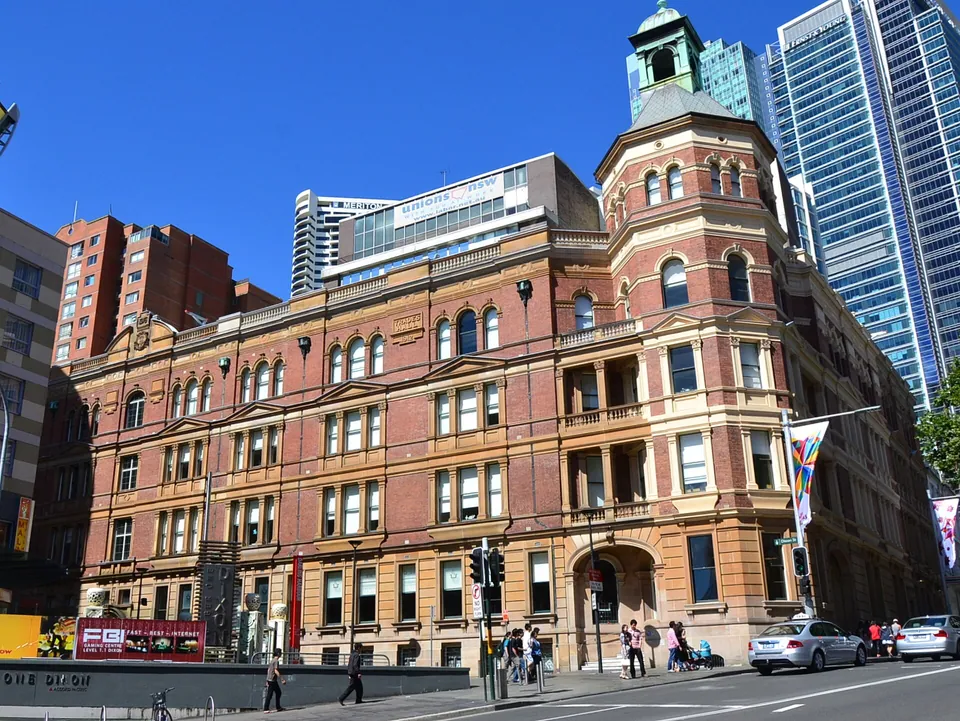
Sydney Trades Hall
4-10 Goulburn Street, Sydney
John Smedley, then Spain, Cosh and Minnett. 1888 to 1916, first opened 1895. Brick.
- Size
- Four storeys and a basement, with a five-storey octagonal tower. About 44 m along Dixon Street on OpenStreetMap. Heights estimated from photographs
- Material
- Load-bearing sandstone ground floor, face brick above with stone trims, copper tower roof
- Status
- State Heritage Register, 1999. Owned by Unions NSW
The land was granted in October 1885 to trustees who included a stonemason, a plumber, an iron moulder, a boilermaker, a draper and a journeyman tailor, to hold for a Trades Hall and Literary Institute. John Smedley, often described as one of the first Australian-born architects, won the design competition. The Governor, Lord Carrington, laid the foundation stone on 28 January 1888, but money ran short, and it opened only on 26 January 1895. “The Trades of the colony will now have a home of their own,” said the Minister, Jacob Garrard.
It grew as the unions did. Spain, Cosh and Minnett added to it in about 1900, 1912 and 1916, keeping closely to Smedley’s pattern of a sandstone ground floor, windows grouped in threes and a balustered parapet, so that it reads as one building. The original is part of the four bays on Goulburn Street, and the seven bays on Dixon Street came later. The register gives the style as Victorian Free Classical, while its own history says Victorian Italianate. The Dictionary of Sydney extends its dates to 1917.
The unions that formed the New South Wales Labor Party had offices here. The Dictionary of Sydney links the hall with the Great Strike of 1917, with recruiting for the First World War, and with the Sydney branch of the Workers’ Educational Association, which began in 1913. A story says that Premier Jack Lang moved the state’s money to the building in 1932, to keep it from the Commonwealth. Others say he only barred federal officials from the Treasury.
The hall still holds its own collections, which the listing says is rare for any union building in the world: a library shelved as it was in 1914, 35 banners over three metres by four, dating from 1885 to 1930, and 70 small silk ones for the eight-hour day processions.
Sources
- Sydney Trades Hall, Wikipedia
- Trades Hall, Dictionary of Sydney