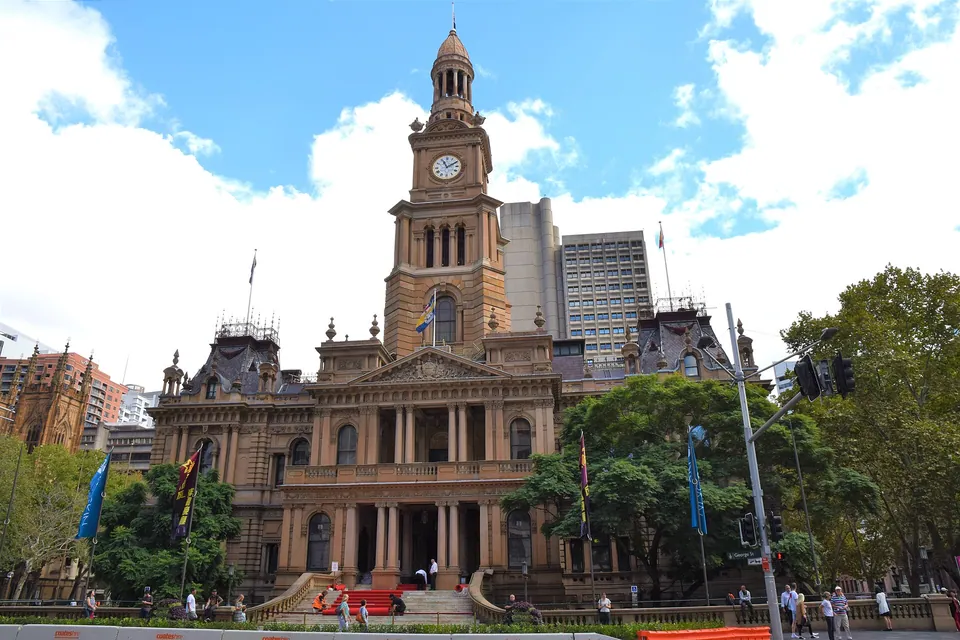
Sydney Town Hall
483 George Street, Sydney
J. H. Willson, then a run of City Architects. 1868 to 1889. Sandstone.
- Size
- Clock tower 55 m above George Street
- Material
- Yellowblock sandstone over brick, slate roofs
- Status
- State Heritage Register, 2010. Still the Lord Mayor’s chambers
It stands on the Old Sydney Burial Ground, set out in 1792 and used until 1820. At least 2,000 people were buried there, and work near the building still turns up graves. Prince Alfred laid the foundation stone in 1868. J. H. Willson, who won the design competition, did not live to finish it, and the City Engineer trimmed his scheme to cut costs.
Building it was rough in every sense. The council moved into the unfinished first stage in 1875, but the foundations of the second stage proved faulty and work stopped. Thomas Sapsford redesigned the hall in 1881, and the listing records “intense political and personal battles” over it. The Centennial Hall opened in 1889, late because its roof girders had to come from England. Inside, the vestibule was finished in at least forty colours, and embossed glass in the first-stage offices carries native plants and animals, one of the earliest known uses of those motifs on a building.
Blasting for the underground railway in 1929 destabilised the old entrance, so the steps people now meet on date only from 1934. They have had a political life since: the hall banned hiring to the Communist Party in 1948, and in the 1970s the steps served as a saluting base for Vietnam marches and later Green Bans demonstrations. In the 2008 to 2009 services upgrade, 6,000 cubic metres of sandstone were dug out from beneath the building.
The stone
The walls are Pyrmont yellowblock, and they keep needing it. A conservation project announced in 2012, reported at $32 to 33 million, began with the clock tower, where ten column capitals had eroded so badly they were recarved, at about two weeks each. In 2020 the City said repairs to the south and west fronts would use yellowblock recovered from city building sites such as 200 George Street.
Sources
- Sydney Town Hall, Wikipedia (incorporates NSW State Heritage Inventory text)
- Final restorations for Sydney Town Hall, City of Sydney