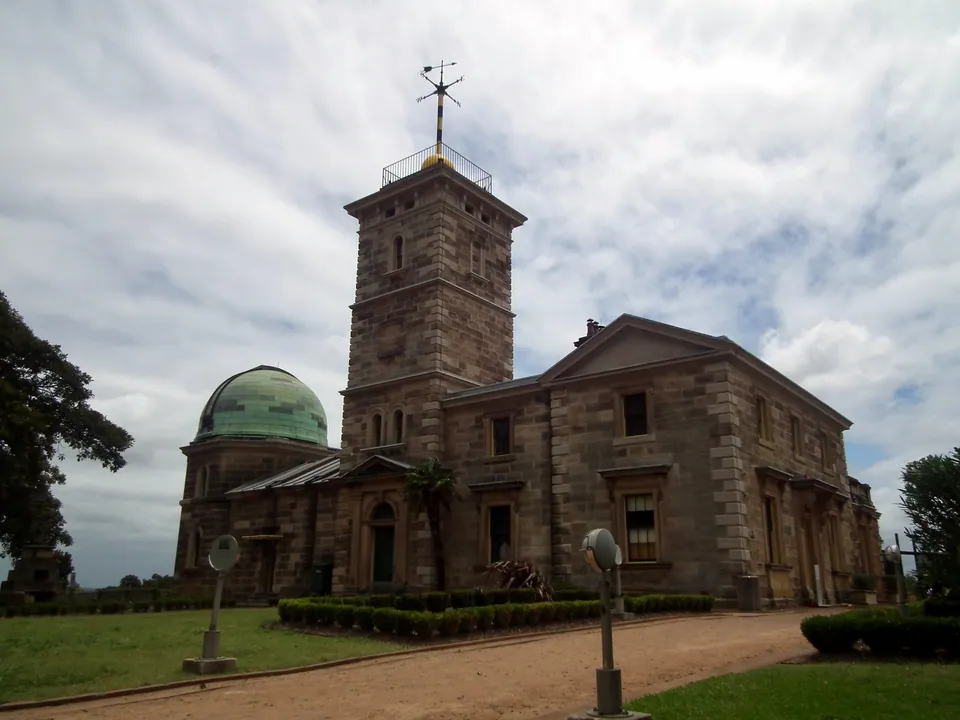
Sydney Observatory
Observatory Hill, Millers Point
William Weaver and Alexander Dawson (sources differ); west wing by James Barnet. 1857 to 1859. Sandstone.
- Size
- Two storeys, with a four-storey tower. No height found, so the drawing is estimated
- Material
- Sandstone, copper-alloy domes, slate roofs
- Status
- State Heritage Register, 2000. A public observatory and museum
This hill had been a windmill, a fort and a flag-signalling station before it became an observatory. The idea began in 1850 as a modest time-ball room, and grew over eight years into an observatory and a house for the astronomer. Colonial Architects came and went during that time. Edmund Blacket drew a first plan, William Weaver resigned in 1855 after an inquiry into overpayments on another job, and Alexander Dawson took over, so sources credit the design to different men.
The result combined two Italian ideas for the first time in a major Sydney building: a symmetrical palazzo for the house, and an asymmetrical villa for the working observatory. The tower gets more prominence than the telescope dome, because its job was to give the city the time. The ball first dropped on 5 June 1858. It was soon moved to one o’clock, and it still falls at 1 pm through the original mechanism, now helped by an electric motor.
In 1925 Cabinet decided to close the place, because of light and traffic vibration, and protests from scientific societies and the public reversed that decision. It finally passed to the Powerhouse as an astronomy museum in 1982.
The stone
A major stone repair project ran from 1999 to 2008. A related government programme sourced replacement stone from Pyrmont and city building sites, but neither what went into this building nor which quarry supplied the 1850s stone could be confirmed.
Sources
- Sydney Observatory, Wikipedia (incorporates NSW State Heritage Inventory text)
- Sydney Observatory building, Dictionary of Sydney
- Time ball at Sydney Observatory, 1858, Powerhouse Collection