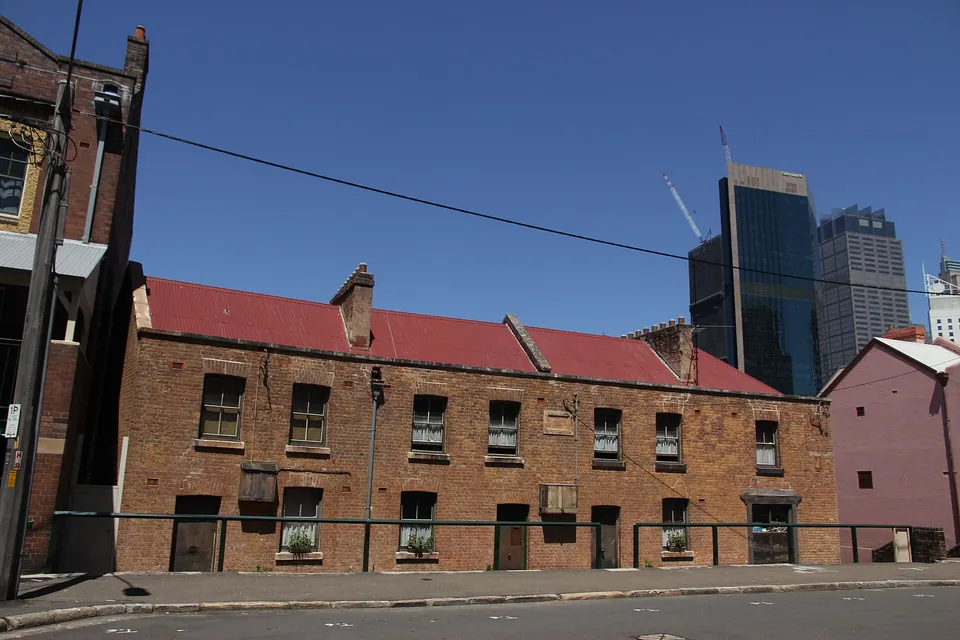
Susannah Place
58-64 Gloucester Street, The Rocks
Builder not recorded, thought to be the owner, Edward Riley. 1844. Brick.
- Size
- Four houses, two storeys to Gloucester Street and three to the rear. About 20 m long on OpenStreetMap. Heights estimated from photographs
- Material
- Colonial bond brick, face and painted, rendered on the Cumberland Place side. Sandstone sills and copings. Corrugated iron replaced the shingle roof late in the nineteenth century
- Status
- State Heritage Register, 1999. A house museum
Edward and Mary Riley arrived from Ireland as assisted immigrants in 1838 with Susannah Sterne, for whom the terrace is named. The heritage record calls her their niece in one passage and Mary’s daughter in another. In 1842 Edward bought land in The Rocks for £450, and by 1844 he had put up four houses on it, though who actually built them is not clear. A tablet on the front gives the name and the year. Each house had six rooms over three levels, with the kitchen in a basement cut into the rock, and the one on the corner was also a shop.
More than 100 working-class families lived here, among them Irish immigrants, Greek shopkeepers and Norwegian sailors. The government resumed the area in 1900 after an outbreak of plague, and the tenants simply stayed. Gloucester Street was raised in the early 1900s, which is why the front doors now sit below the footpath.
In 1971 the Sydney Cove Redevelopment Authority told residents they would be moved, and a quote was obtained to demolish the row in 1978. The Rocks Resident Action Group and the Builders’ Labourers Federation had by then imposed a Green Ban on the area. The Marshalls at number 62 stayed on until 1990 as unofficial caretakers.
Conservation began in 1987. Work finished in 1992 at a cost of $250,000, stabilising the plaster, repairing parapets and gutters and replacing timber eaten by white ants. The layers of paint and wallpaper were kept, and the corner shop has been recreated as it was in the 1910s.
Sources
- Susannah Place, Wikipedia
- Susannah Place, Sydney Living Museums
- Susannah Place Museum, Sydney.com, Destination NSW