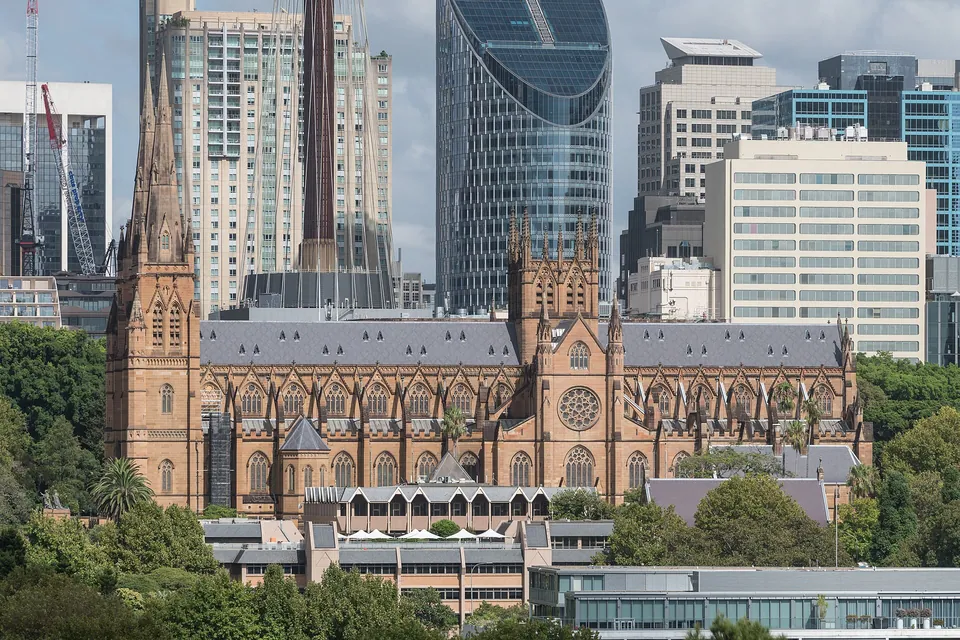
St Mary’s Cathedral
College Street, Sydney
William Wardell. 1868 to 2000. Sandstone.
- Size
- Spires 74.6 m
- Material
- Golden Sydney sandstone, slate roof
- Status
- State Heritage Register, 2004. A working cathedral
Sydney’s first Catholic church was begun here in 1821 and burned down in 1865. Archbishop Polding wrote to William Wardell, a friend of Pugin, with a free hand: “Any plan, any style, anything that is beautiful and grand.” Polding laid the foundation stone in 1868, but died in 1877, five years before the dedication. The nave was begun only in 1913 and dedicated in 1928. If you look closely inside, a slight change of colour and texture on the walls marks the join.
For most of the twentieth century the two towers on the front stood as flat-topped stumps. A government grant for the millennium paid for Wardell’s spires at last. Steel frames were lowered onto the old towers by helicopter, a crane on the frames lifted the blocks, and the job finished in June 2000, 132 years after the foundation stone.
The front owes something to Notre Dame in Paris, with its three portals and central rose window, and the chancel window is close to a copy of Lincoln Cathedral’s. The heritage listing calls it the largest nineteenth-century church in the English Gothic style anywhere. Carving on the main front doors was never finished, but the transept doors facing Hyde Park were completed by local craftsmen, and include waratahs.
The stone
The cathedral is a catalogue of stones: Sydney sandstone for the fabric, New Zealand’s Oamaru stone for the altars and screen, Italian marble inside. The Archdiocese says the spires are “sheathed in Gosford sandstone”, since Pyrmont yellowblock was no longer available. Salt air and acid rain attack the soft blocks, and since 1996 the cathedral has used facade gommage, a dry cleaning method from France, in a conservation programme planned to last 70 years.
Sources
- St Mary's Cathedral, Sydney, Wikipedia (incorporates NSW State Heritage Inventory text)
- History of the Cathedral, St Mary's Cathedral
- How to clean a cathedral, Australian Geographic
- William Wardell, Wikipedia
- Wardell, William Wilkinson, Dictionary of Sydney