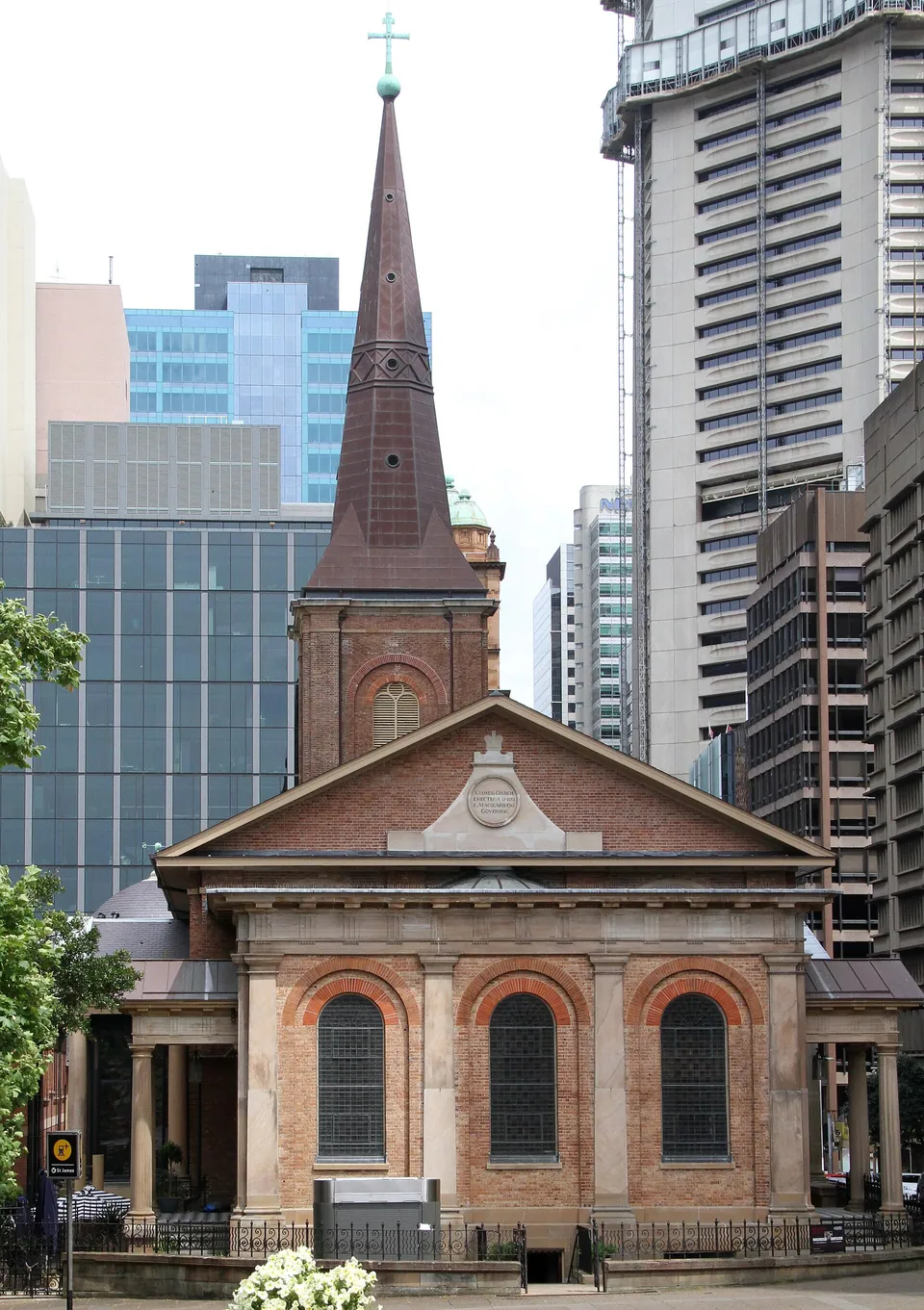
St James’ Church
173 King Street, Sydney
Francis Greenway, with vestries by John Verge, 1834. 1820 to 1824. Brick.
- Size
- Spire 46 m. About 53 m by 25 m over the porticos on OpenStreetMap. Other heights estimated from photographs
- Material
- Local brick with stone footings and dressings, a copper-sheathed spire and a Welsh slate roof
- Status
- State Heritage Register, 2004. Still a parish church
It was meant to be a courthouse. Macquarie and Commissioner John Bigge laid the foundation stone on 7 October 1819, while Macquarie planned a large cathedral elsewhere. By February 1820, less than four months after arriving, Bigge had put a stop to the cathedral and strongly recommended that the courthouse become a church instead. Greenway added a steeple at the western end, and the school buildings beside it became the court. The first service was held in the unfinished church on 6 January 1822, and it was consecrated in February 1824.
Greenway’s plan is a simple rectangle, its walls divided by brick pilasters, its roof carried over the end walls to form pediments. He aligned it with his barracks across Queens Square, and the two share their proportions, pilasters and gables. Before high-rise buildings, the spire served as a guide for ships coming up the harbour. John Verge added the eastern vestries and their two small porticos in 1834.
The trustees leased out the parsonage to pay for restoration in 1894, when Varney Parkes replaced the spire in pre-weathered copper. Beneath the church a groin-vaulted brick undercroft has served as a home for the first rector’s widow, as a parish school and as a shelter for armed forces in both world wars. Its Children’s Chapel, opened in 1929, has murals designed by Ethel Anderson.
The spire was restored again from 2008 to 2010, with its masonry, framing and copper. Spanish slates fitted in the 1970s proved unsuited to Sydney’s climate because of their high iron content, and they have been replaced with Welsh slates. The Royal Australian Historical Society describes St James’ as the oldest church building in Sydney in continuous use for its original purpose.
Sources
- St James’ Church, Sydney, Wikipedia
- A groundbreaking bicentenary: St James’ Church, Royal Australian Historical Society