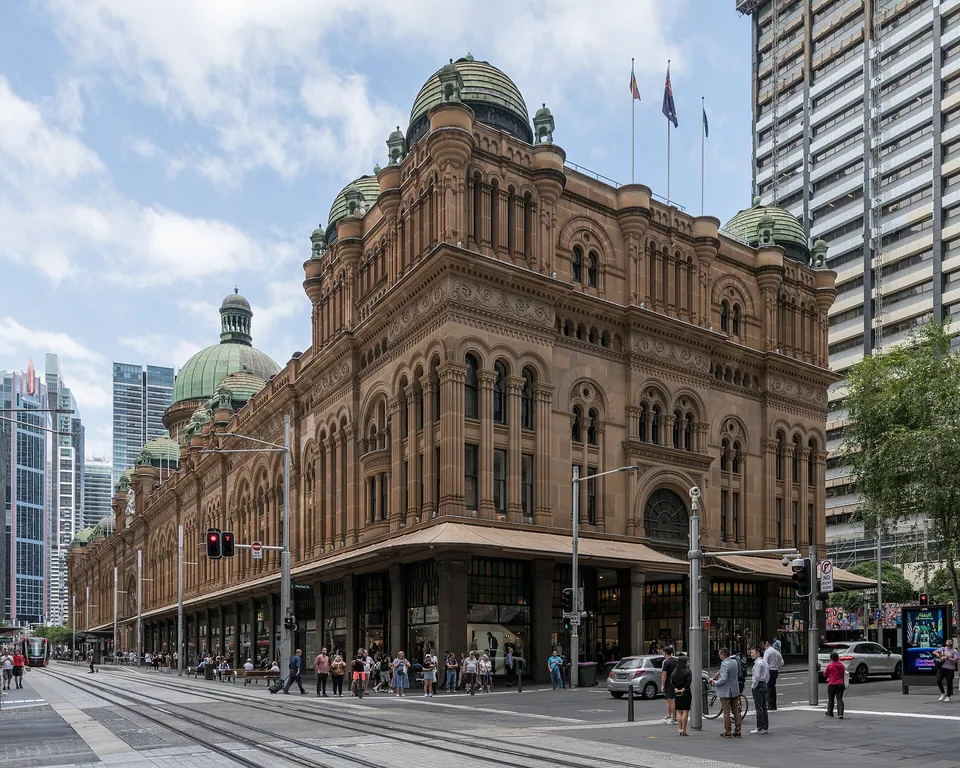
Queen Victoria Building
429-481 George Street, Sydney
George McRae, City Architect. 1893 to 1898. Sandstone.
- Size
- 190 m long, 30 m wide, about 60 m to the top of the central cupola
- Material
- Sydney sandstone over brick and concrete, trachyte stairs and columns, copper domes
- Status
- State Heritage Register, 2010. Still a shopping centre, on a 99-year lease from the City
George McRae, a Scottish architect who had arrived in Sydney in 1884, drew four versions of this block: Gothic, Renaissance, Queen Anne and Romanesque. The council took the last. It named the building for Queen Victoria’s Diamond Jubilee but chose not to ask for her assent, partly because that would have meant displaying the royal arms. When it opened as a market in July 1898, about 1,000 Welsbach burners lit it and only 47 of roughly 200 spaces had tenants.
It never paid its way. The markets left in 1910, and a 1913 vote to remodel it rather than sell it or knock it down passed by 10 votes to 9. Alterations in 1917 boxed in the trachyte columns and covered the tiled floor. A scheme in the 1930s fitted out offices for the Electricity Department and removed the glass inner dome and both grand staircases. By then the debt had reached £500,000.
In 1959 the Lord Mayor proposed demolishing it for a square over a car park. In 1961 Harry Seidler called it an architectural monstrosity. From 1963 its rooftop cupolas were taken off, and the contractor sold them as souvenirs and garden decorations. The National Trust, the architects’ institute and a group called the Friends of the Queen Victoria Building campaigned against demolition, Barry Humphries wrote satirical verse about the threatened demolition, and in May 1971 the Lord Mayor announced it would be restored, though there was no money to do it.
Rescue came from Malaysia. Ipoh Garden signed a 99-year lease in 1983 and reopened the building in November 1986, at a reported cost of about $86 million. Almost nothing of the original interior had survived, so the heritage listing calls what you walk through today an “interpretive reconstruction”. Above the awning line, the fronts are largely intact, if heavily conserved.
The stone
Nobody agrees where the stone came from. The heritage text says the Phippard Brothers’ quarry at Waverley; other accounts say Pyrmont, or Maroubra walls with Pyrmont only for the carving. Today the drum of the great dome is rendered concrete painted to look like stone, and the small cupolas are fibreglass painted to look like copper.
Sources
- Queen Victoria Building, Wikipedia (incorporates NSW State Heritage Inventory text)
- Queen Victoria Building, Dictionary of Sydney
- About the QVB, Queen Victoria Building