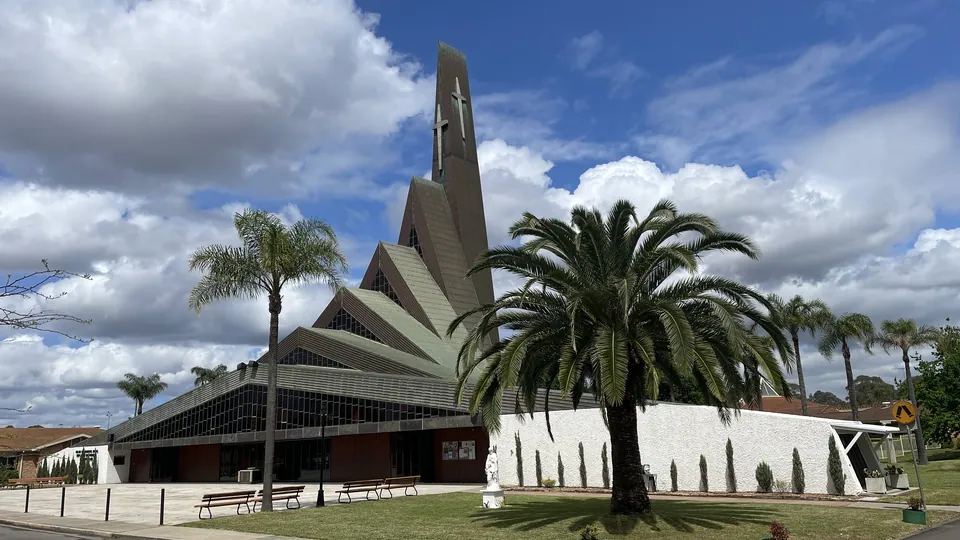
Polish War Memorial Chapel
116-132 Quakers Road, Marayong
Michael Dysart. 1964 to 1966 in Harper’s survey; consecrated 27 December 1966. A church directory gives 1966 to 1967. Brutalism.
- Size
- No dimensions found. The drawing is estimated from photographs, with the tower at about 36 m
- Material
- Rough-cast render and copper, with glazed gable ends
- Status
- No heritage listing found. The church of the Polish Catholic community, served by the Society of Christ
The chapel stands at the Polish centre on Quakers Road, which began with a home for Polish children. Sydney’s Polish community built it to serve Poles across New South Wales, and it is dedicated to Our Lady of Częstochowa, Queen of Poland. The Diocese of Parramatta records that Cardinal Norman Gilroy consecrated it in 1966, and a 2024 account gives the date as 27 December 1966. A church directory gives the building years as 1966 to 1967. The Australian War Memorial lists it among its memorials of the Second World War.
Michael Dysart designed it. Six gables rise one behind another to a tall tower clad in copper, with a cross on its face. Each gable end is filled with small panes of glass, and the long low walls are rendered white. The diocese says the six peaks stand for the six million Polish lives lost in the war, that the tower draws on the shrine of Jasna Góra and on the Sydney Opera House, and that from above the building resembles an eagle in flight.
Glenn Harper’s survey of Sydney Brutalism pairs it with the Reader’s Digest offices in Surry Hills for their “exuberant form and detailing”. He describes early work that joined a strong treatment of materials with “a romanticised sense of ‘place making’”, and the chapel shows it in its white rough-cast walls, its copper gables and its tower. In the same years, Harper records, Dysart was project architect for Kuring-gai High School and Pennant Hills High School in the Government Architect’s office.
Read about Brutalism in Sydney
Sources
- The Brutalist Project Sydney, Glenn Harper, Byera Hadley Travelling Scholarships Journal Series, NSW Architects Registration Board (2016)
- Polish War Memorial (Multicultural Chaplaincy), Catholic Diocese of Parramatta
- Marayong – The Heart of Poland in Australia’s Multicultural Landscape, Exaudi (2024)
- Polish War Memorial Chapel, Churches Australia
- Our Lady of Czestochowa Queen of Poland Catholic Church, Australian War Memorial, Places of Pride