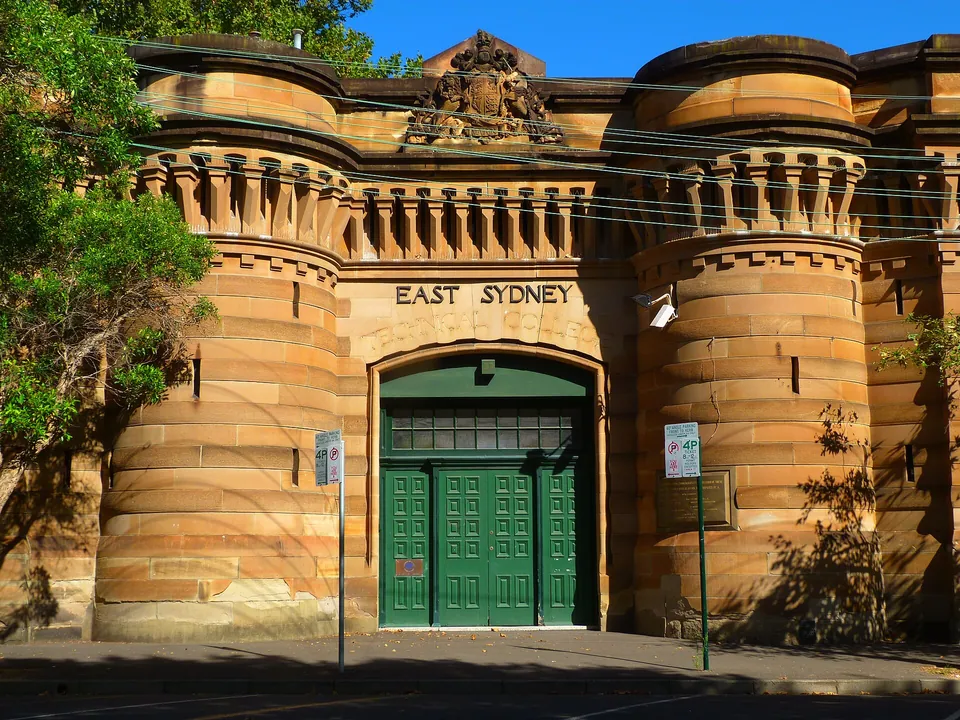
National Art School (Darlinghurst Gaol)
Forbes Street, Darlinghurst
Francis Greenway pegged the site; Mortimer Lewis designed most of it, altered by George Barney. 1822 to 1841. Sandstone.
- Size
- Perimeter wall 6.5 m high when complete
- Material
- Unpainted ashlar sandstone, conical and hipped slate roofs
- Status
- State Heritage Register, 2021. An art school since 1922
Francis Greenway pegged out this site in 1821, and convicts built the perimeter wall from 1822 to 1824. Then the money ran out and it stood empty for twelve years. Mortimer Lewis’s design for the rest began in 1836, and the first prisoners moved in from the old George Street gaol on 7 June 1841. Its radial plan, with a tall round chapel at the centre and six cell blocks around it, followed the prison reformers of the day.
Hangings were public at first. Crowds gathered at this gate in Forbes Street, where the condemned were brought out onto a scaffold in front of it and later a platform above it. The last public hanging here was in 1852, and later ones took place on a gallows inside the walls. Sources count either 76 or 79 executions. Louisa Collins, in 1889, was the last woman. Henry Lawson was locked up here seven times between 1905 and 1909.
The gaol closed in 1914 and held internees during the First World War. In 1921 and 1922 it passed to the Department of Education as East Sydney Technical College, and the National Art School began here. So the same stone that held prisoners has held life-drawing classes for over a century, and the old women’s wing later became an experimental theatre.
The stone
Convicts cut the blocks of the 1822 wall by hand. Convict markings are reported along the upper half of the wall on Darlinghurst Road, though this could not be confirmed from a second source. A replacement unicorn’s head for the coat of arms, carved in 2023, was made from stone dug out at Alfred Street, Circular Quay, and is expected to oxidise to match.
Sources
- Darlinghurst Gaol, Wikipedia
- Darlinghurst Gaol, Dictionary of Sydney (archived by State Library of NSW)
- Blog post on the hanging of Francis Green at Darlinghurst Gaol, Dictionary of Sydney (archived by State Library of NSW)
- History page, National Art School
- The Sydney workshop where hundred-year-old sculptures are made new, ABC News
- Set in Stone: A History of the Cell Block Theatre, UNSW Press
- Henry Lawson, Wikipedia