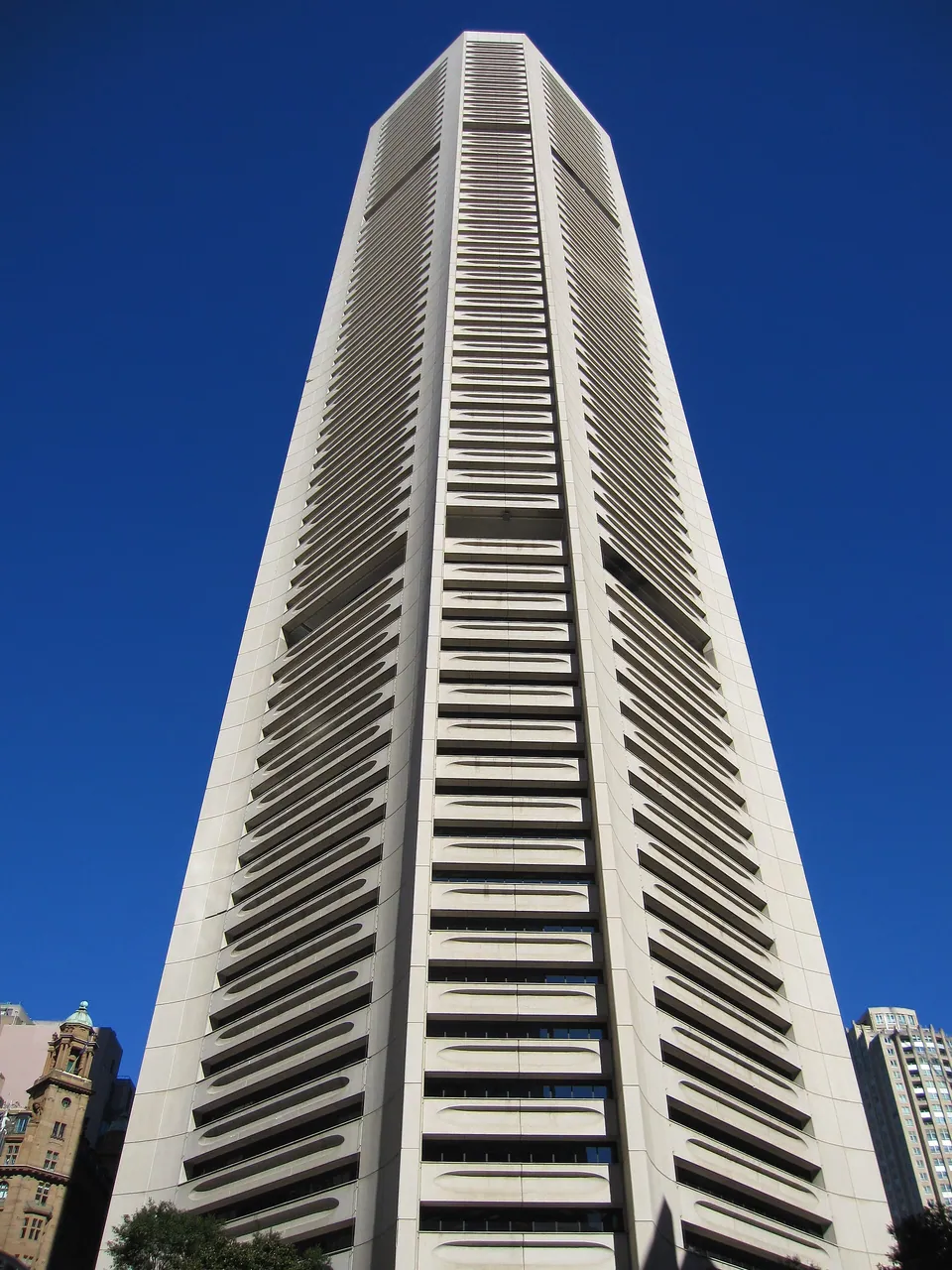
MLC Centre (25 Martin Place)
19-35 Martin Place, Sydney
Harry Seidler, with Pier Luigi Nervi as structural consultant. 1972 to 1978. Modernism.
- Size
- 228 m, 67 storeys
- Material
- Reinforced concrete with a white quartz finish, part precast and part cast in place
- Status
- Local heritage item, Sydney LEP. Offices, shops and the Theatre Royal
Lend Lease and the MLC assembled 23 properties into a site of about 0.9 hectares, and some 14 schemes were drawn as it changed. In 1970 Lend Lease announced a tower of 305 metres. The Hotel Australia closed at the end of June 1971 and was demolished. The Theatre Royal gave its last performance on 29 April 1972, and the Builders Labourers Federation placed a ban on demolishing it. Dick Dusseldorp offered to include a new theatre in the scheme, and the ban was lifted. The new Theatre Royal opened in January 1976, and the Governor-General opened the finished centre in September 1978.
The tower stands on about 20 per cent of the site, placed to avoid railway lines running diagonally beneath it, which left room for plazas stepping up from Martin Place. Eight columns carry its weight, turned out at the foot and tapering until they are flush with the face at the top. The Australian Institute of Architects describes the white quartz columns and spandrels as precast forms into which concrete was poured on site, at a cycle of one floor every four days. The spandrels are shaped like an I-beam, with the depth changing along the span, and the windows sit back behind them for shade. Nervi developed the ribbed ceiling of the lobby and the mushroom column of the Commercial Travellers club.
Its inventory gives it as the tallest building in Australia for nine years, the tallest in Sydney from 1977 until 1992, and the tallest reinforced concrete building in the world when completed. It won the Civic Design Award in 1981 and the Sulman Medal in 1983, jointly with John Andrews’ American Express Tower, Seidler’s fourth. A $100 million repair added corrosion protection to the facade panels, and new plaza buildings by Seidler’s office were under construction in 2020. The owner, Dexus, dropped the name in 2021 in favour of the street address.
Read about Modernism in Sydney
Sources
- MLC Centre inventory report, City of Sydney (2020)
- 25 Martin Place (MLC Centre), Wikipedia
- MLC Centre, Sydney, State Library of NSW