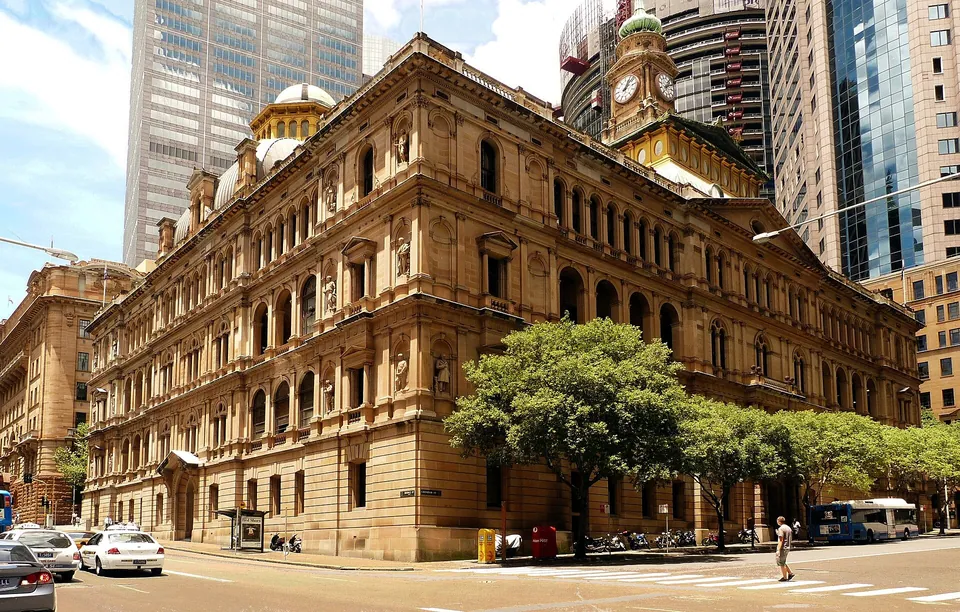
Lands Department Building
Bridge Street, Sydney
James Barnet, Colonial Architect. 1876 to 1892. Sandstone.
- Size
- A whole block, on a basement and three storeys. No height found, so the drawing is estimated
- Material
- Dressed Pyrmont sandstone, copper dome and tower cap, statues in sandstone
- Status
- State Heritage Register, 1999. Now The Lands by Capella, an events, dining and retail venue; the first event spaces opened in February 2026, with the rest due by late 2026
This was the office of the people who surveyed and sold the colony. Barnet built it in two stages, in 1876 to 1881 and 1888 to 1892, in an Italian Renaissance style with Doric pilasters at the bottom, Ionic above and Corinthian on top, and every one of its four fronts different. The first stage used concrete floor slabs by the builder John Young, an early advocate of the material. The heritage listing says the copper onion on the clock tower was inspired by Sir Henry Parkes’s water carafe.
The building is best known for its statues. Barnet planned twelve niches on each front. In 1890, at Parkes’s urging, he proposed 48 men “who have devoted themselves to the exploration of Australia”, and the list was promptly attacked, with names struck out as “hunters or excursionists” or as “more enterprising colonists than explorers”. It was recommended that some niches stay empty for future generations who might give “eminent service in the great question of ‘The Land’”. Many still are: the count of finished statues varies by source, at about 23 or 24, and a figure of the surveyor James Meehan went in as late as 2010.
The building also holds a quiet distinction. A bench-mark plug on the building’s front provided the origin of all levels in New South Wales under the Survey Co-ordination Act. In the late 1980s it was earmarked as a possible casino, and the resulting fuss won it a permanent conservation order.
The stone
The heritage listing records dressed Pyrmont sandstone. William Priestly MacIntosh, James Fillans, Tomaso Sani, James White and Alexander Sherriff carved the statues, a good chance to compare hands on one building.
Sources
- Department of Lands Building, Wikipedia (incorporates NSW State Heritage Inventory text)
- Lands Department Building, Dictionary of Sydney
- The Lands by Capella Events opens, The Lands by Capella (press release, 2 February 2026)