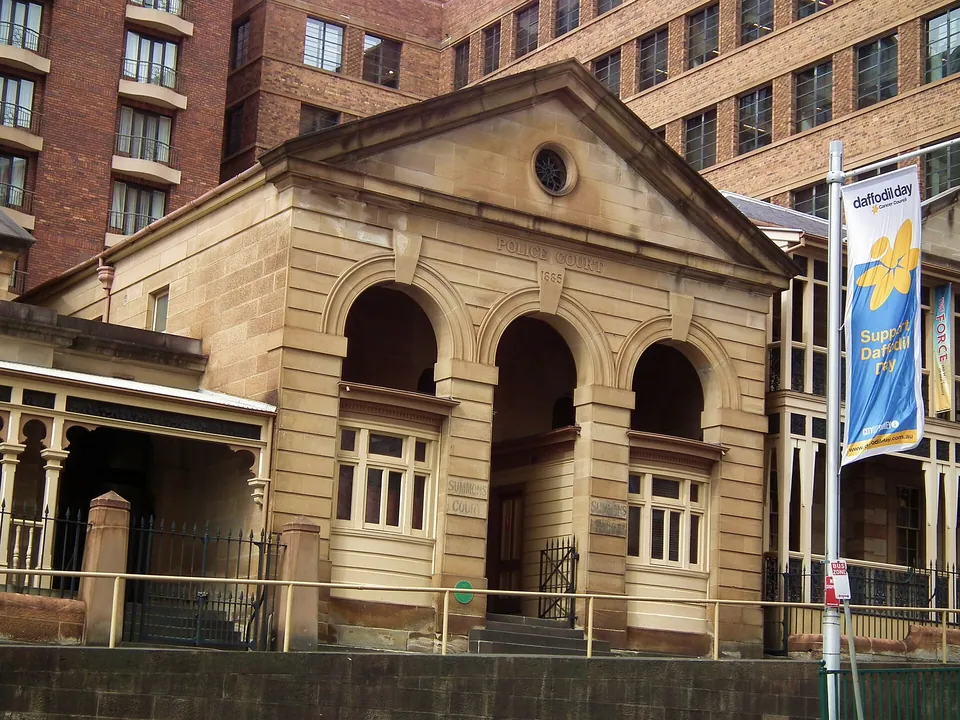
Justice & Police Museum
4-8 Phillip Street, Sydney
Edmund Blacket, Alexander Dawson and James Barnet. 1856 to 1886. Sandstone.
- Size
- One and two storeys. No dimensions found, so the drawing is estimated
- Material
- Banded sandstone ashlar, slate roofs, timber verandah with cast iron
- Status
- State heritage listed. Whether the museum is currently open could not be confirmed
This small group was the Water Police’s base near Circular Quay. In 1853 work began on quarrying sandstone for it at Bennelong Point, where the Opera House now stands, but the gold rushes drove up prices and drained away labour, and the job dragged. Blacket’s first court, with its three-arched portico, was finished in 1856. Dawson’s police station followed in 1858, cut down by the same shortages to a plain building with four water policemen and their families living upstairs. Barnet added a second court in 1885 to 1886, repeating Blacket’s portico.
The courts were never grand. They heard petty crime, harbour and shipping offences and small debts, and later became the traffic courts, staying in use until 1979. The Water Police moved to Dawes Point in 1913. The museum’s collection began as a 1910 police teaching collection of criminal implements.
The stone
Look at the banding, the strongest in this set of buildings: cream and orange beds alternate through the walls, which makes it a good place to see the iron colouring in the rock. The heritage text mentions stone from Bennelong Point for the first building and Pyrmont stone for the station, though it’s not clear how much came from each.
Sources
- Justice and Police Museum, Wikipedia
- Water Police Court, Dictionary of Sydney (archived by State Library of NSW)
- Justice and Police Museum, Destination NSW (sydney.com)
- Water Police Court 1886, Sydney, Will's Hub