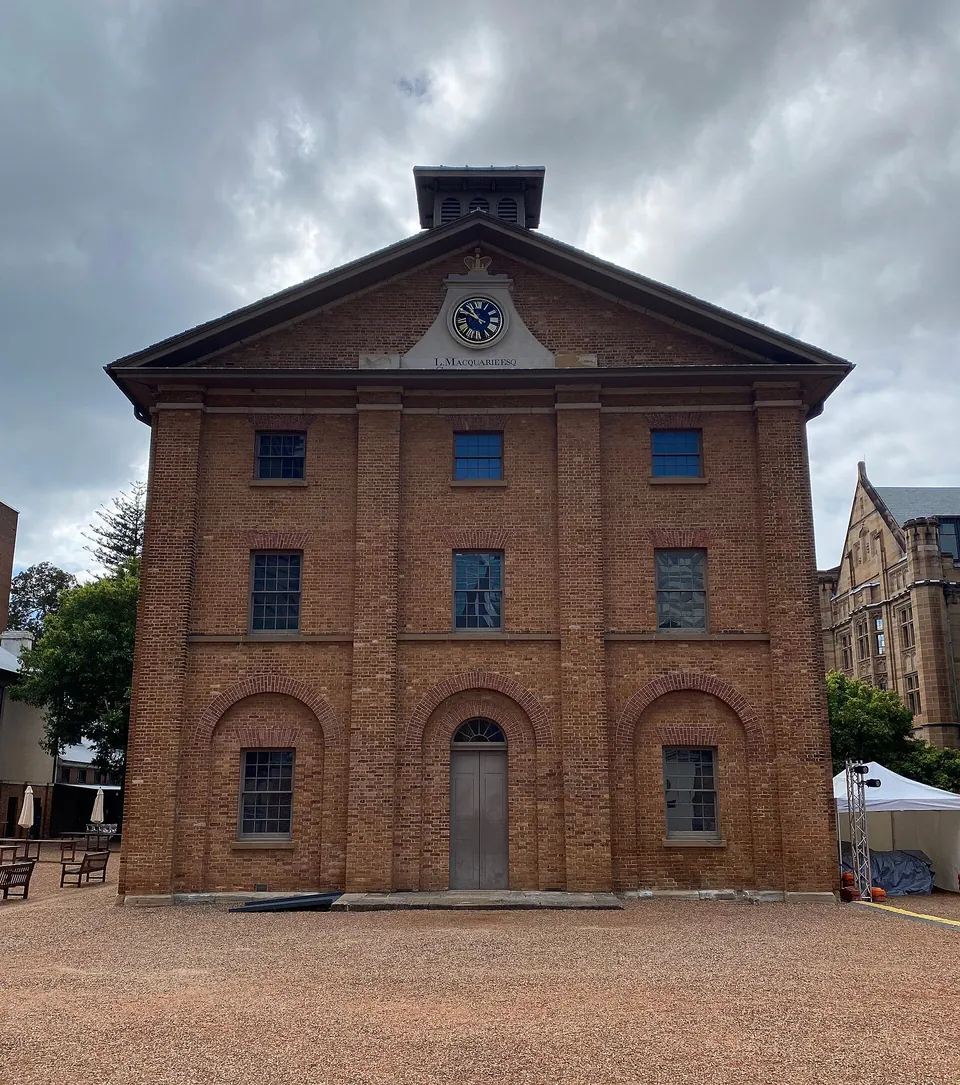
Hyde Park Barracks
Queens Square, Macquarie Street, Sydney
Francis Greenway. 1817 to 1819. Brick.
- Size
- Three storeys, about 40 m long. No published dimensions found. OpenStreetMap traces the front at 18.5 m; photographs against people at the door suggest about 16 m, which the drawing uses, with its heights estimated
- Material
- Sandstock brick on sandstone foundations, with stone sills and string courses and a timber shingle roof. The stonework and shingles are replacements
- Status
- World Heritage List, 2010, with the National and State Heritage Registers. Now a museum
Until 1819 most convicts in Sydney found their own lodgings. Governor Macquarie, disturbed by their behaviour in the streets after work, asked the convict architect Francis Greenway to design barracks for 600 men. Macquarie laid the foundation stone on 6 April 1817, convicts built it with soft sandstock bricks that give it an orange colour, and it opened on 4 June 1819, when 589 men were admitted. Macquarie was pleased enough to give Greenway a full pardon soon after it was finished.
Each of the three floors has four rooms opening off two corridors that form a cross. The rooms were hung with two rows of hammocks, each hammock allowed 2.1 by 0.6 metres, so the long eastern rooms slept 70 men and the smaller western rooms 35. Up to 1,400 were housed at one time, and perhaps 30,000 men and boys passed through by 1848. Macquarie reported that night robberies fell by nine tenths. Commissioner Bigge complained that the barracks had simply gathered “depraved and desperate characters” in one place.
When the convicts left in 1848 it became the Female Immigration Depot, which took in single women arriving as servants, many of them escaping the Irish famine. An asylum for infirm and destitute women occupied the top floor from 1862 to 1886. Scraps of cloth and paper from those years lay concealed in the cavities between floors for up to 160 years, until archaeologists recovered them in the 1980s, a record of institutional life for women.
Courts then filled the site until the 1970s, and internal walls and fibro buildings multiplied around them. The courts sitting here approved the basic wage in 1927. Conservation began in 1975, and work in the late 1980s returned the outside to its appearance of about 1820. In 2010 it was inscribed on the World Heritage List with ten other Australian convict sites.
Sources
- Hyde Park Barracks, Sydney, Wikipedia
- The Hyde Park Barracks, by George Repin, Pittwater Online News