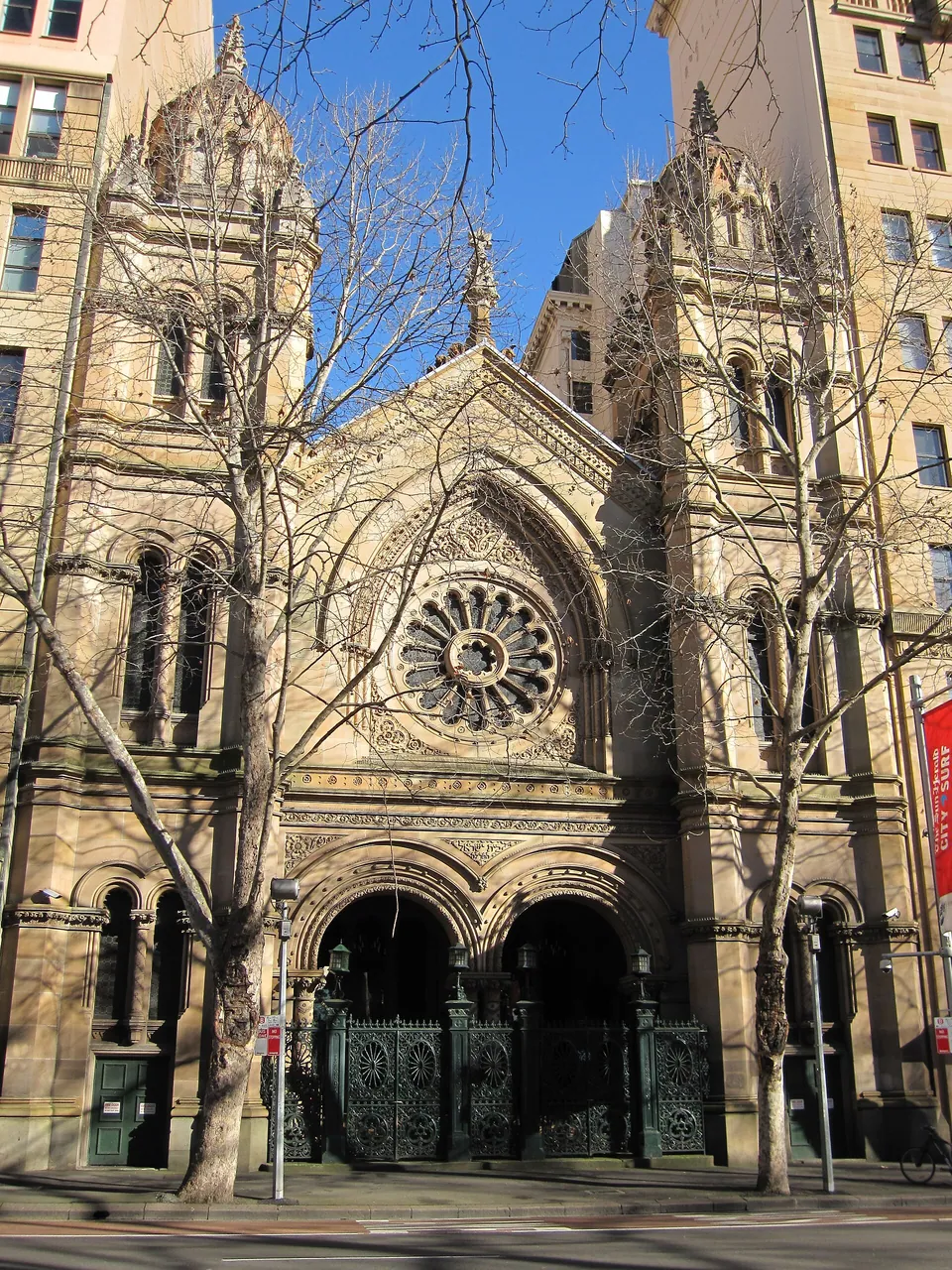
The Great Synagogue
187a Elizabeth Street, Sydney
Thomas Rowe. 1874 to 1878. Sandstone.
- Size
- Front proportions are estimated from a photograph. No height found
- Material
- Pyrmont stone front and towers on a brick body, cast-iron gates
- Status
- State Heritage Register, 2004. A working Orthodox synagogue
The Great Synagogue was built to unite two Sydney congregations, one in York Street and one in Macquarie Street. In 1871 the builder John Solomon bought the Elizabeth Street site at auction for £2,000 and held it while the community raised the money. Thomas Rowe, a Cornish architect in Sydney, won a limited competition in 1872. Saul Samuel, the Postmaster General and the first Jewish minister of the Crown in the British Empire, laid the stone in January 1875.
It was consecrated in March 1878, facing Hyde Park between what are now tower blocks. An 1878 newspaper called its style Byzantine with Gothic characteristics. The heritage text is more exact: Romanesque decoration, Gothic arches and a few Moorish touches inside. The Fletcher Brothers’ foundry made the cast-iron gates, restored in 2023, and Lyon & Cottier made the glass.
What you see from the street isn’t the whole story. Only the Elizabeth Street front and towers are stone. Behind them it’s brick, with cast-iron columns and timber floors, and the Castlereagh Street end has stone only at ground level. It shows how Sydney often spent its stone: on the side the city would see.
The stone
The heritage listing records Pyrmont stone. Aaron Loveridge, founder of the firm Loveridge & Hudson, held the stonework contract, and Thomas Wran, who also carved the General Post Office’s keystones, did the carving. Stone from the old Paradise quarry, lifted at Jacksons Landing from 2000, later went into repairs here.
Sources
- Great Synagogue (Sydney), Wikipedia
- Great Synagogue, Dictionary of Sydney (archived by State Library of NSW)
- The Great Synagogue Foundation Stone, State Library of NSW
- A history of the Great Synagogue, Sydney, OzTorah (Rabbi Raymond Apple)
- Thomas Wran, Wikipedia