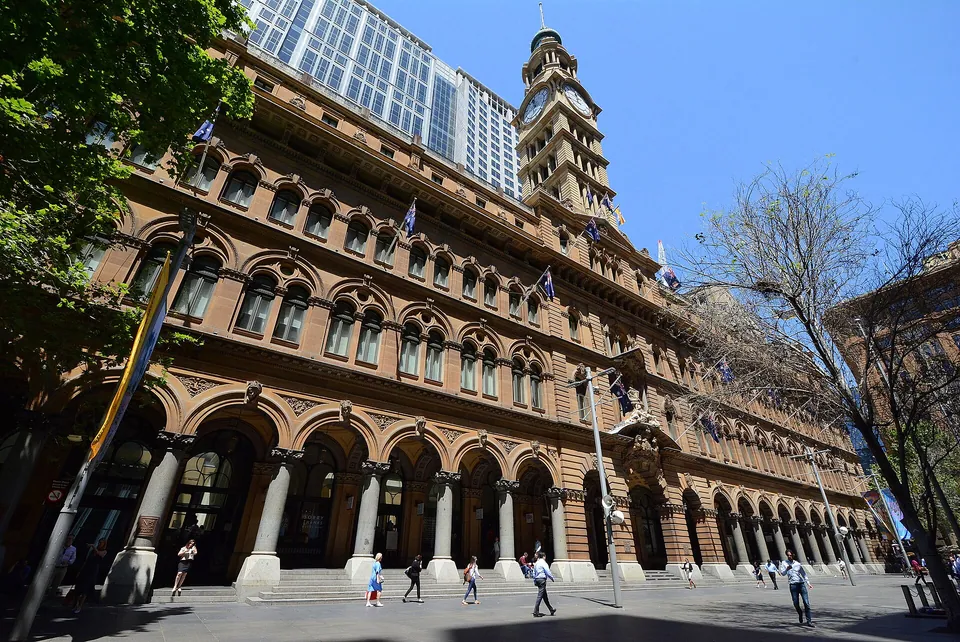
General Post Office
1 Martin Place, Sydney
James Barnet, Colonial Architect. 1866 to 1891. Sandstone.
- Size
- Martin Place front about 100 to 114 m. Tower quoted at 64, 70, 73 and 83 m; the Commonwealth listing says 70 m
- Material
- Pyrmont sandstone, polished Moruya granite columns, Sicilian marble statuary
- Status
- State and Commonwealth heritage lists. Now a hotel, shops and offices
Martin Place exists because of this building. When James Barnet began it, its colonnade faced St Martin’s Lane, only three metres wide. The government bought the land opposite, and the lane became a public square. The keystone over the George Street entrance, a 26-ton block of Pyrmont stone, was set by the Duke of Edinburgh in 1869. A local history says it came from Saunders’ Paradise quarry behind 26 Clydesdales, though that account has its date wrong.
Barnet’s real trouble was the carving. Three sculptors worked on the building. Thomas Wran made the royal arms and 24 keystone heads, personifying continents and colonies as a monument to the telegraph’s defeat of distance. Giovanni Fontana carved Queen Victoria from his London studio. Tomaso Sani’s spandrels on the Pitt Street side showed realistic figures, some of them caricatures of real people, and in 1883 they caused a row in parliament and a board of inquiry. One member defended them as “the beginning of art in Australia”. In 1890 the Assembly voted 54 to 5 to keep them, and Barnet’s department was abolished soon after.
The clock tower was taken down in 1942 to make the building harder to bomb, and its stones were kept in storage. When it went back up in 1964, with the original stone, the word Eternity was found chalked inside the bell, in the hand of Arthur Stace. After the 1989 Newcastle earthquake, engineers drilled the tower and prestressed part of it. Australia Post moved out in the 1990s, and the freehold sold for $150 million in 2017.
The stone
Barnet chose polished Moruya granite for the arcade columns because of the weight on “small points of support”, and had the Pyrmont sandstone of the galleries and spandrels cut in sizes, he said, “which had never been attempted in Australia”. The front was restored in 1988 and cleaned without chemicals in about 2019.
Sources
- General Post Office, Sydney, Wikipedia (incorporates NSW State Heritage Inventory text)
- Commonwealth Heritage List record, place 105509, Australian Heritage Database, Australian Government
- Sydney's General Post Office, Canada Bay Heritage Society