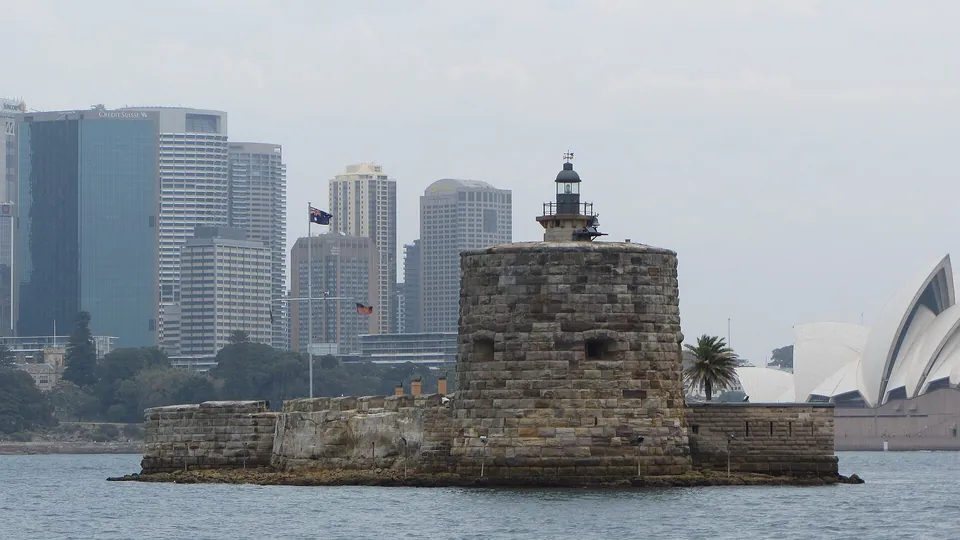
Fort Denison
Sydney Harbour, about 1 km east of the Opera House
George Barney, the colony’s civil engineer. 1841 to 1857, with flanking rooms to 1862. Sandstone.
- Size
- Tower walls 2.7 m thick at the top. The tower was reported as 51 feet (about 15.5 m) high in 1857; the drawing is estimated
- Material
- About 8,000 tonnes of sandstone from Kurraba Point; the battery is cut from the island’s bedrock
- Status
- State Heritage Register, 1999. Part of Sydney Harbour National Park, and closed through 2026 for conservation work
Before the British it was Mattewanye, or Muddawahnyuh, a small rocky island known to the Eora. The colonists called it Pinchgut. In 1788 a convict was sentenced to a week there on bread and water, and in 1796 Francis Morgan was hanged and gibbeted on it. Convicts then levelled and quarried the islet, which had stood somewhere between 15 and 23 metres high depending on the source, to build Circular Quay. John Dunmore Lang called this “the folly of man”, one of the city’s earliest heritage objections.
After two American warships slipped into the harbour at night in 1839, George Barney recommended a fort. Work started in 1841, stopped, and resumed in 1855 out of fear of Russia. It was named for Governor Denison and reported finished in November 1857, though the conservation plan dates completion, with two flanking rooms, to 1862. It holds the only Martello tower in Australia. It’s also said to be the last built in the British Empire, though Brehon Tower off Guernsey and the towers at Pembroke Dock were finished around the same time. Three 32-pounder guns are still inside, because the passages are said to be too narrow to get them out.
The fort never fired in anger. It did get fired on. In May 1942, shells from USS Chicago, aimed at Japanese midget submarines, hit the tower, and the marks remain. It also has a quieter scientific life: tides have been measured here since 1857, first from a bench mark, with continuous gauge records from 1866, and tide heights for other places in New South Wales are still referenced to the gauge.
The stone
The fort shows the stone at its limits. Salt has soaked its porous blocks “right down to the fort’s foundations”. Yellowblock replacement stone, with less quartz and more clay, mostly failed here before 2007. Since then repairs have used a quartz-rich sandstone from Wilton, near Appin, which has lasted far better.
Sources
- Fort Denison Conservation Management Plan, NSW Office of Environment and Heritage
- Fort Denison, Wikipedia
- Fort Denison, Dictionary of Sydney
- Fort Denison - Muddawahnyuh, NSW National Parks and Wildlife Service
- Martello tower, Wikipedia