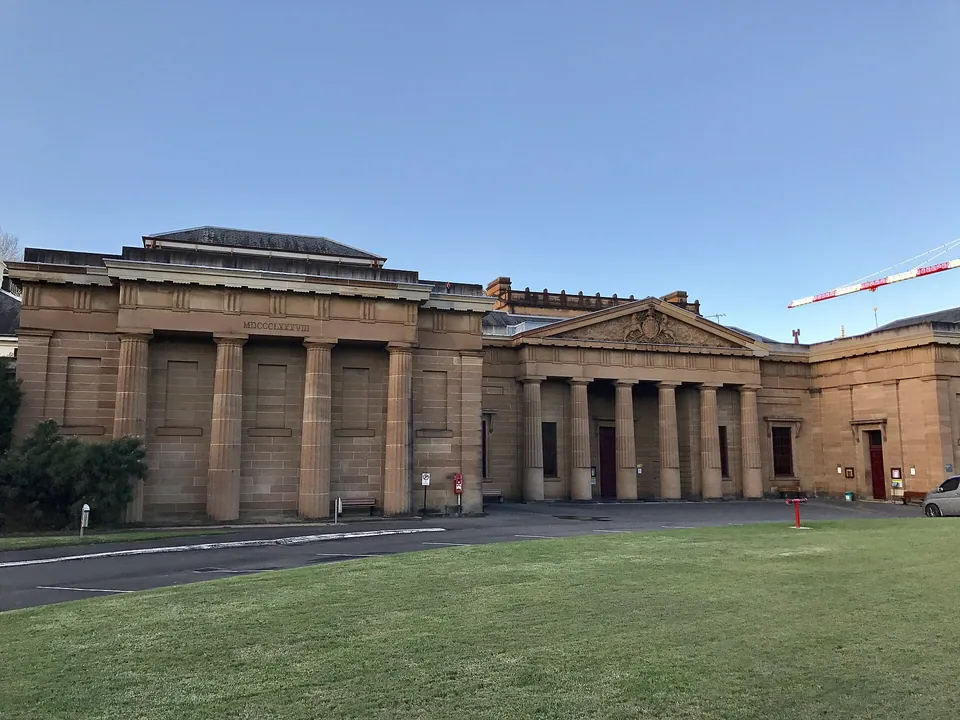
Darlinghurst Courthouse
Taylor Square, Darlinghurst
Mortimer Lewis, Colonial Architect; pavilions by James Barnet. 1837 to 1844, pavilions 1884 to 1888. Sandstone.
- Size
- One tall storey. No dimensions found, so the drawing is estimated
- Material
- Smooth dressed sandstone, fluted stone Doric columns, slate roof
- Status
- State Heritage Register, 1999. Used mainly by the Supreme Court
Prisoners were being marched through the city from the old gaol in George Street to the court in King Street, and Governor Bourke wanted that to stop. So Mortimer Lewis designed a courthouse right beside the new Darlinghurst Gaol, with a prison dock between the two. The heritage text calls it the first purpose-designed courthouse in New South Wales, though Greenway’s Windsor Court House of 1821 to 1822 is older. Convict gangs laid the foundations, and sittings began in 1842 in an unfinished building.
Lewis’s style was meant to show the authority of the law. The heritage listing calls this the finest and only erudite Old Colonial Grecian public building complex surviving in Australia, and the severity is the point: plain columns, no windows on the front, and hardly any decoration beyond the royal arms. Barnet’s large pavilions of 1884 to 1888 kept to the same language. His date is cut in Roman numerals on one of the friezes.
From 1903 it was a Sydney seat of the new High Court of Australia, which got its own building at Taylor Square in 1923 and moved to Canberra in 1980. The Supreme Court still sits here, in the middle of Oxford Street’s nightlife.
The stone
No source consulted names the quarry or the masons. The stone here is cut smooth, a contrast with the rough convict-hewn wall of the gaol just behind. The roof has given more trouble than the walls: Blacket had to repair it in the 1850s when it was in danger of collapse, and the whole thing was replaced in 1901.
Sources
- Darlinghurst Courthouse, Wikipedia
- Darlinghurst Courthouse, Dictionary of Sydney (archived by State Library of NSW)
- Windsor Court House, Wikipedia
- Mortimer Lewis, Wikipedia