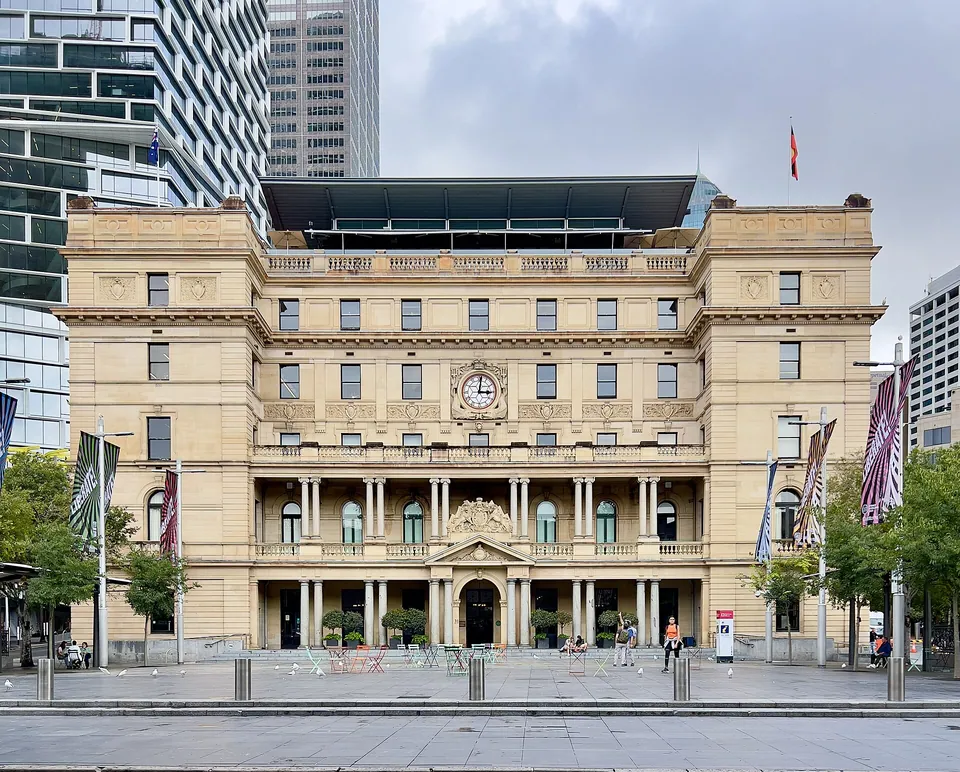
Customs House
Alfred Street, Circular Quay
Mortimer Lewis, then James Barnet, Walter Liberty Vernon and George Oakeshott. 1843 or 1844 to 1845, rebuilt 1885 to 1887. Sandstone.
- Size
- Six levels; other sources count five. No overall height found, so the drawing is estimated
- Material
- Sandstone street fronts on load-bearing walls, with a steel and concrete frame inside
- Status
- State and Commonwealth heritage lists. Now the City of Sydney Library
Sydney’s first customs house, of 1800, is presumed to have stood at or near this spot, close to where the First Fleet landed. The sandstone building that replaced it was pushed through by Colonel John Gibbes, Collector of Customs for 25 years, who persuaded Governor Gipps to start in 1844, partly as relief work for unemployed masons during a depression. Mortimer Lewis gave him a plain two-storey block with thirteen large windows facing the harbour, so that the customs men could watch the shipping. Gibbes could watch it rise from his own verandah across the water at Kirribilli.
It was never comfortable. Built on reclaimed land, it was cold and damp, and by the 1880s it was overcrowded and dilapidated. James Barnet rebuilt it in 1885 to 1887, with an extra storey, wings and the portico, and according to the Dictionary of Sydney only Lewis’s Long Room survived. Vernon then raised it to five storeys, and in 1915 to 1917 George Oakeshott replaced the inside with a steel and concrete frame. The heritage listing praises how three government architects kept to the same materials and proportions, so that it still reads as one building.
Federation raised its importance, because customs duties were the Commonwealth’s main early income. Customs left in 1990. The City of Sydney took it over, sources disagree exactly when, and now a 1:500 model of the city centre lies under a glass floor in the ground-floor hall.
The stone
No source consulted names its quarry or the carver of the royal arms. In 2016 the City warned that without conservation the sandstone fronts “will continue to deteriorate in a manner causing safety risks to passers-by”, and called tenders for repairs.
Sources
- Customs House, Dictionary of Sydney
- History of Customs House, City of Sydney
- Customs House, Sydney, Wikipedia (incorporates NSW State Heritage Inventory text)