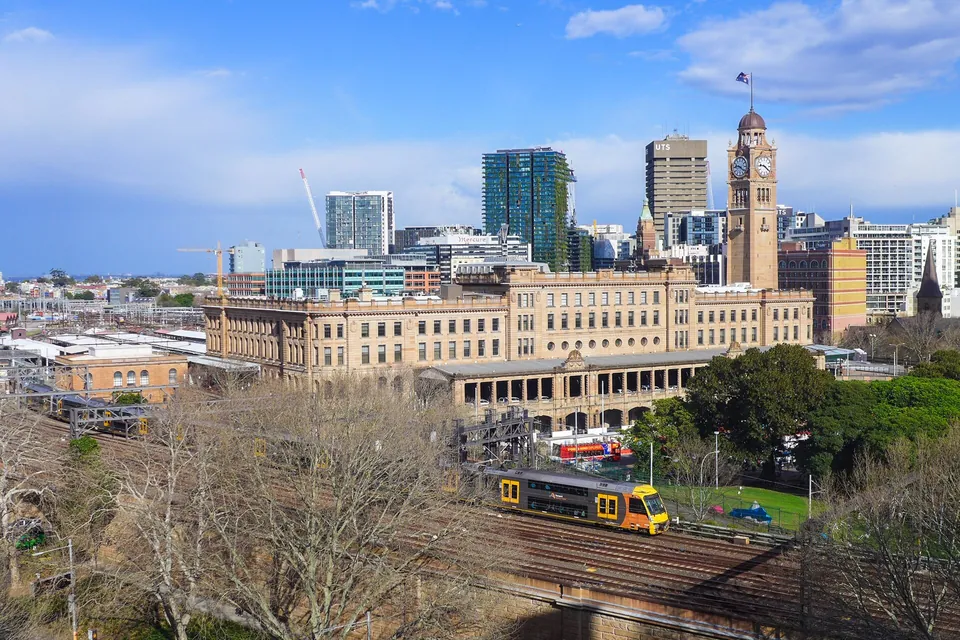
Central Station
Eddy Avenue, Haymarket
Government Architect’s Branch under Walter Liberty Vernon, with Henry Deane; front reputedly by Gorrie McLeish Blair. 1901 to 1906, upper storeys and clock tower to 1921. Sandstone.
- Size
- Clock tower 75 m. The 85.6 m also quoted appears to be its tip above sea level
- Material
- Pyrmont sandstone, with a brick east wing; copper dome on the tower
- Status
- State Heritage Register, 1999. Australia’s busiest railway station
In 1901 a Station Advisory Board was told to produce “a monumental work of stateliness and beauty”. The site was the Devonshire Street Cemetery, and by the end of that year 1,145 bodies had been moved privately. Most of the bodies moved went to a new cemetery at La Perouse at government expense. A first scheme with pavilions and a mansard roof, like a French chateau, was dropped, because a parliamentary committee had decided that major public buildings should be all sandstone and not brick with stone trim.
Then it got bigger. In 1902 it gained a storey, extra length and a tower, and its estimate rose from £230,000 to about £400,000. Economies followed: the train shed was deleted, and when funds ran short the east wing on Elizabeth Street was finished in brick, breaking the very rule that had shaped the design. The last train left the old station at midnight on 4 August 1906, and the Western Mail pulled into the new one the next morning.
The clock tower came fifteen years later, in 1921, and became known as the working man’s watch. In 1916 soldiers rioted at the station and gunfire was exchanged. A bullet hole in the marble at the entrance to platform 1 is the only trace.
The stone
Here the paperwork survives. On 21 July 1902 the first order for stone went to Saunders at Pyrmont, and eleven masons began dressing it in the quarry on 7 August. The first dressed stone reached the site on 18 August. By mid-1903, 127,000 cubic feet had been built in.
Sources
- Central railway station, Sydney, Wikipedia
- Central Railway Station, Dictionary of Sydney (archived by State Library of NSW)
- Happy 100th Birthday Central Station Clock Tower, National Trust of Australia (NSW)
- Central Station Sydney page, Railways and Tramways of Australia
- Sydney's Central Station Clock Tower is 100 Years Old, Surry Hills News