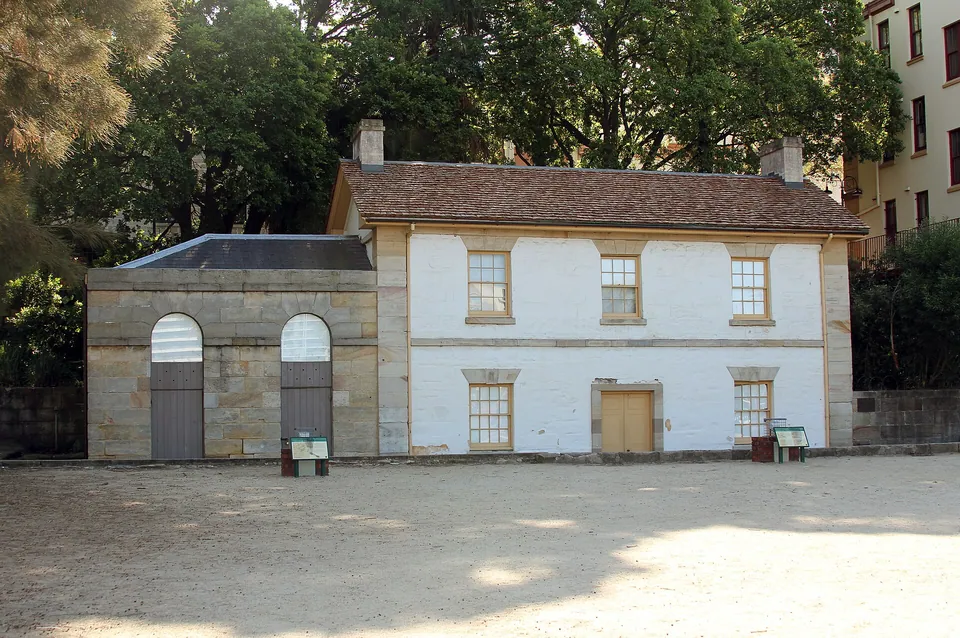
Cadmans Cottage
110 George Street, The Rocks
Unknown. A link to Francis Greenway is not substantiated. About 1816. Sandstone.
- Size
- Two storeys. No dimensions found, so the drawing is estimated
- Material
- Whitewashed sandstone rubble, dressed sandstone plinth, string courses and pilasters
- Status
- State Heritage Register, 1999. Closed for conservation works at last report
No document records when this was built. Its date comes from a drawing by James Wallis, made in the first months of 1816, which shows a finished two-storey stone building at the water’s edge. It was the Coxswains’ Barracks, beside the Government Dockyard, built hard against a rock shelf so that part of its lower floor is natural bedrock. The heritage text calls it the oldest building in The Rocks and the third oldest in the city, while other accounts call it the oldest or second oldest surviving house.
It takes its name from John Cadman, the longest-serving government coxswain. He was transported in 1798 for horse stealing, held a pardon by 1814, and lived here from 1827 until he retired in 1845. The Water Police followed, and then it became part of a Sailors’ Home until 1970.
The sea left it behind. Filling, probably around 1870 to 1875, cut it off from the water, and Circular Quay now lies about 100 metres away. A 1972 restoration tried to return it to its early form, and in doing so removed much of the evidence of its later life. The shingle roof and big chimneys you see today are reconstructions, and the chimneys are larger than any shown in the old sketches. The heritage listing says the masonry is the only major element left from the original period.
The stone
Rubble walls were cheap, and this building shows the old colonial trick of keeping dressed stone for what showed: the plinth, the string courses, the corners and the openings. A lintel engraved G.R., for George III, came to light in 1972. The same work sandblasted the walls, so little original tooling is likely to survive on them.
Sources
- Cadmans Cottage, Wikipedia
- Cadman's Cottage, Dictionary of Sydney (archived by State Library of NSW)
- Cadman's Cottage, The Rocks (Placemaking NSW)