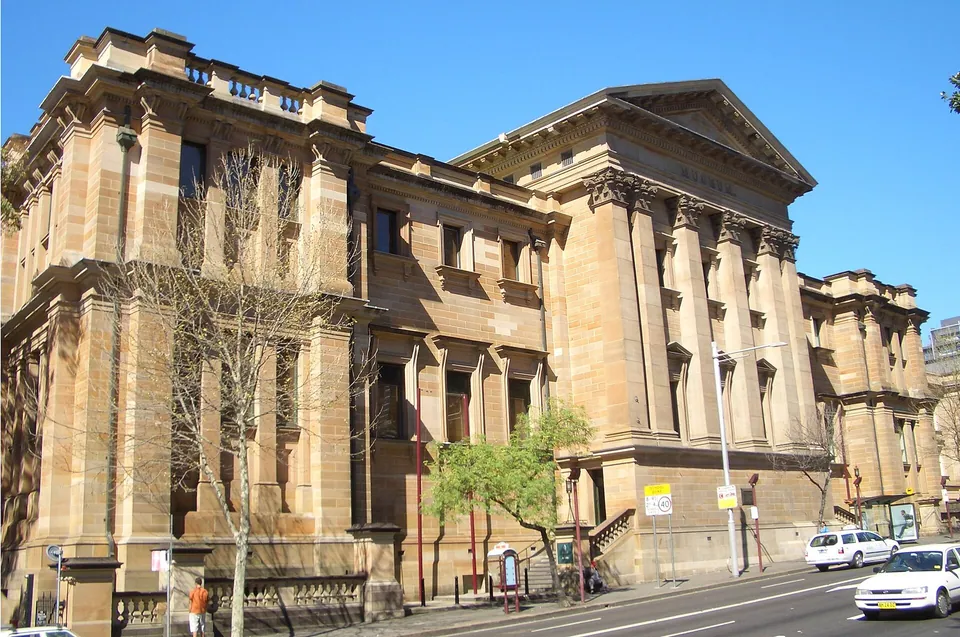
Australian Museum
College and William Streets, Sydney
Mortimer Lewis, then Alexander Dawson and James Barnet. 1846 to 1866, with later wings. Sandstone.
- Size
- Three storeys on the College Street front. No height found, so the drawing is estimated
- Material
- Sydney sandstone, with modern glass additions on William Street
- Status
- State Heritage Register, 1999. Reopened in 2020 after a $57.5 million upgrade
This is Australia’s oldest natural history museum, and its home took years to get built. Mortimer Lewis started a two-storey Greek Revival building in 1846, and work stopped when a scandal over the public money spent on it led to his resignation as Colonial Architect in 1849. It opened in 1857 with a single display hall, and was thought inadequate almost at once.
The College Street front was meant to be part of something far grander. Alexander Dawson planned large additions, and his clerk of works, James Barnet, developed them into “a grand neo-classical composition” with a columned portico, a carved pediment and a dome behind. The trustees adopted it in 1861, intending a palace for a museum, a library and an art gallery. Only this section was built. The museum itself describes it as “a noble side entrance to a domed palace” that never came.
Later building filled in around it. A third storey went on Lewis’s wing in 1890 to 1892, Vernon’s south wings followed, and a modern wing of 1963 nearly doubled the space. A foyer built between the old wings in the late 1980s lets visitors see the stonework of each phase side by side, which makes this one of the easiest places in the city to compare them.
The stone
The local sculptor Walter McGill did the carving on Barnet’s wing. A NSW Government history lists the museum among buildings of Pyrmont yellowblock, with later extensions in stone from the eastern suburbs.
Sources
- Our buildings through time, Australian Museum
- Australian Museum, Dictionary of Sydney (archived by State Library of NSW)
- Australian Museum officially reopens, Australian Museum
- Australian Museum, Wikipedia
- Mortimer Lewis, Wikipedia