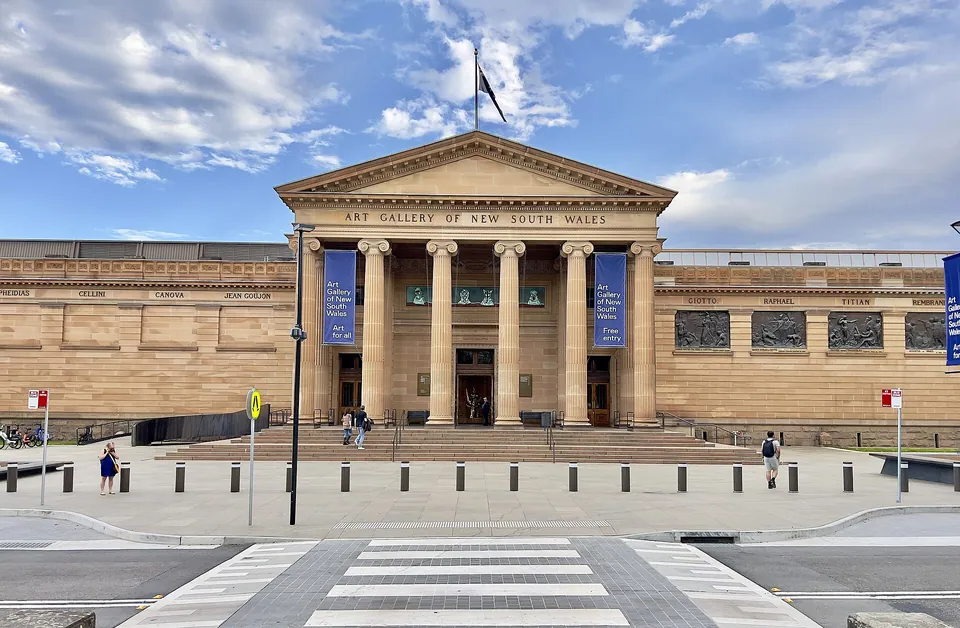
Art Gallery of New South Wales
Art Gallery Road, The Domain
Walter Liberty Vernon, Government Architect. 1896 to 1909. Sandstone.
- Size
- Not found in a reliable source; the drawing’s proportions are estimated from a photograph
- Material
- Freestone and trachyte, bronze lettering and relief panels
- Status
- A public gallery, with later wings around it. On the State Heritage Inventory
Vernon preferred Gothic, arguing it allowed more individuality than “the colder and unbending lines of Pagan Classic”. The trustees wanted a temple to art, something like the National Gallery of Scotland, and they were paying. They had already engaged John Horbury Hunt, whose temporary brick building with a saw-tooth roof the press denounced as the Art Barn. It survived until about 1969.
The building went up in stages from 1896, with its oval lobby in 1902 and the front finished in 1909. Vernon’s larger plan, with a central court behind the lobby, was abandoned. Below the entablature run 32 names chosen by the trustees’ president, Frederick Eccleston Du Faur: Raphael, Titian, Rembrandt, Canova and others. None of them had a work in the gallery at the time. Calls to swap in Australians failed because the trustees couldn’t agree who should go up.
The facade was meant to carry far more sculpture. The trustees planned six bronze reliefs on the arts of six periods, and only four were made, none of them in order: Percival Ball’s Greece in 1903, Gilbert Bayes’s Assyria in 1907, Feodora Gleichen’s Egypt in 1908 and William Reid Dick’s Rome in 1931. Gothic and Renaissance never came. A chariot race commissioned from the expatriate sculptor Dora Ohlfsen in 1913 got as far as plaster before it was cancelled in 1919. The niche stayed empty for about a century, until Karla Dickens’s To see or not to see was installed in 2022.
The stone
An 1897 newspaper quoted by the gallery describes the front as “thracyte [sic] and freestone”. No source consulted names its quarry, although a NSW Government history lists the gallery among the buildings of Pyrmont yellowblock.
Sources
- Art Gallery of New South Wales, Wikipedia
- Site history, Sydney Modern Project, Art Gallery of NSW
- Dora Ohlfsen, Art Gallery of NSW
- Karla Dickens: To see or not to see, Art Gallery of NSW
- Facade commission announcement, Art Gallery of NSW
- The Offerings of Peace and The Offerings of War, Wikipedia